Looking Beyond Speech Sound Labels: A New Way to Understand Children’s Speech
If your child is in speech therapy, you may have heard terms like speech sound disorder, phonological delay, or apraxia of speech. These labels are often used to describe how a child’s speech sounds compared to other children their age.
But speech is more than sounds.
Speech is a complex motor skill—one that requires the brain and body to work together to coordinate the jaw, lips, tongue, airflow, and timing. New research is helping speech therapists better understand what’s happening under the surface when children struggle to speak clearly.
At Brave Wings Therapy, this research directly shapes how we evaluate and treat children.
Not All Speech Errors Mean the Same Thing
Two children can make the same speech mistakes, yet struggle for very different reasons.
One child may:
Know exactly what they want to say but have difficulty coordinating mouth movements
Speak clearly in short words but struggle as sentences get longer
Have speech that sounds different from day to day
Another child may:
Be learning how sounds work in words
Need help organizing sound patterns
Improve quickly with sound-based practice
If we only focus on what the error sounds like, we miss why it is happening. Understanding the reason behind the difficulty helps us choose the right type of support.
Speech Errors Are Part of Learning
Speech develops just like other motor skills. When children are learning to walk, they wobble. When they learn to write, letters are messy. Speech is no different.
Many speech “errors” are actually a child’s best attempt with the skills they have at that moment. These patterns tell us how their speech system is developing—and what it needs next.
At Brave Wings Therapy, we see speech errors as valuable information, not failure.
Why One Label Doesn’t Tell the Whole Story
Traditional speech labels can be helpful, but they don’t always explain:
Why a child is hard to understand
Why progress may be uneven
Why therapy looks different from one child to another
New research shows that many children don’t fit neatly into one diagnosis. Instead of placing children into a single category, clinicians are encouraged to look at each child’s unique speech profile.
This means understanding how your child’s speech system works—so therapy can be tailored specifically to them.
What This Means for Your Child’s Therapy
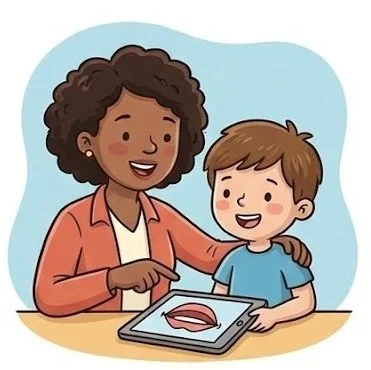
Using this research-informed approach allows us to:
Individualize goals based on how your child learns
Adjust support and cues as skills improve
Explain progress in clear, meaningful ways
Build confidence and communication together
Therapy may sometimes focus on sounds, sometimes on movement, and sometimes on practice structure—but every choice is intentional and designed to support long-term success.
A Proud Moment for Brave Wings Therapy

We are especially proud to share that Brave Wings Therapy co-owner, Dr. Jennifer Moore, is a co-author on this peer-reviewed research paper.
Dr. Moore worked alongside subject matter experts from around the world—leaders in speech motor development and pediatric speech disorders—to help advance how the field of speech-language pathology understands and classifies speech sound disorders.
This means that the care your child receives at Brave Wings Therapy is informed not only by current research, but by a clinician who is actively helping shape the future of the field.
Research That Guides Our Care
This work was published in the international journal Frontiers in Human Neuroscience and is available to clinicians and families worldwide.
Reference:
Namasivayam, A. K., Kent, R., Preston J. L., Maassen, B. A. M., Hagedorn, C., Nip, I. S. B., McAllister, A., Wang, J., Hustad, K., Menard, L., Bahar, N., Moore, J., Petrosov, J., & van Lieshout, P. Reevaluating the classification of pediatric speech sound disorders: A ground truthing perspective. Frontiers in Human Neuroscience. doi 10.3389/fnhum.2025.1700505
Our Commitment to Your Family
At Brave Wings Therapy, we believe:
Every child’s speech journey is unique
Understanding leads to better outcomes
Therapy should adapt as your child grows
Families deserve clear explanations and evidence-based care
If you ever have questions about your child’s speech, their goals, or how therapy decisions are made, we are always here to talk. Your child’s voice matters—and we are honored to support it.